New York Driver’s Permit Test: Your Complete Guide to Requirements, Prep, and Online Testing
The New York learner’s permit is the first formal step toward a full driver’s license. It lets you log supervised behind-the-wheel practice while you complete required education and waiting periods. This guide walks you through who’s eligible, what’s on the written DMV test, how to prepare with timed practice and targeted study, and whether you can take the permit test online. You’ll find exactly which documents to bring, the topics the NY permit covers, step-by-step online testing instructions, and what comes next after you pass — including pre-licensing classes and the stages of New York’s Graduated Driver License (GDL) program. Along the way we point to official resources and recommend course-style prep options that use realistic practice to raise pass rates and speed your path to the road test.
What Are the Eligibility Requirements for a New York Learner’s Permit?
You can get a New York learner’s permit if you meet the state’s age, identity, residency, and vision standards and complete the required application steps. In many cases you’ll also need to show proof of your Social Security number. You must submit a completed application and pass a vision screening so you can safely take part in supervised driving. Knowing these basics ahead of time helps you avoid DMV delays and ensures you bring the right paperwork the first time. Below we break down age and residency rules, then list the exact documents you should prepare and why they matter.
What Age and Residency Criteria Must You Meet for the NY Learner’s Permit?
Most applicants become eligible at age 16 through New York’s Graduated Driver License program; older first-time applicants can also apply. The DMV verifies residency with documents that show your New York address, and minors often need parental consent or proof of guardianship. These rules ensure DMV records reflect legal responsibility and confirm state jurisdiction for issuing a permit. If you meet the age and residency requirements, the next step is collecting identity and Social Security documentation before you visit the DMV.
Which Documents Are Required for the New York Permit Application?
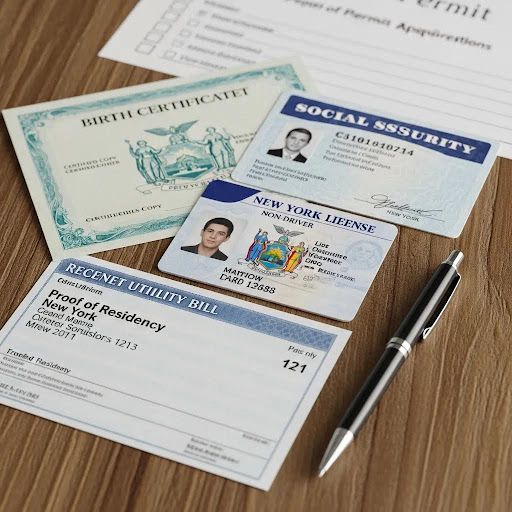
- Proof of Identity
- Social Security Proof
- Proof of Residency
- Application Form
- Vision Screening
Bring clear, unexpired documents to speed processing and avoid rescheduling. Common mistakes include old addresses or mismatched names — double-check each item matches your legal name and New York address.
How Do You Prepare for the New York DMV Written Permit Test?
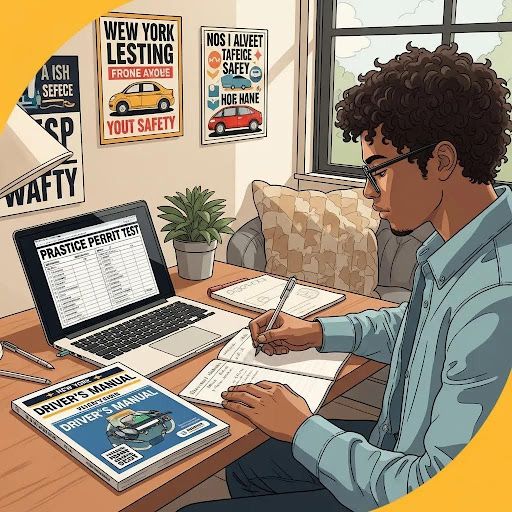
Preparing for the NY DMV written test means studying road signs, traffic laws, and safe-driving practices, and building confidence with realistic practice tests that mirror DMV timing and question formats. The most effective method combines repeated retrieval and simulation: read the Driver’s Manual, take state-specific practice quizzes, and review missed questions to close knowledge gaps. This approach builds the judgment needed for scenario-style questions on exam day. Below we list the test topics and example question types, then explain how to use practice tests strategically to improve results.
What Topics Are Covered on the NY DMV Written Test?
The written exam tests four main domains: road signs, rules of the road, safe driving practices, and impaired or distracted driving laws. Questions focus on recognition, application, and judgment. For example, sign questions ask you to identify meanings from images, while rules-of-the-road items use short scenarios to test right-of-way and lane use. Knowing these domains helps you target study time with the New York Driver’s Manual and focused practice quizzes.
Test Topic: Road Signs, Rules of the Road, Safe Driving Practices, Impaired Driving & DUIs
Typical Question Type: Identify the sign’s meaning from an image, Scenario-based right-of-way and lane questions, Select best-practice responses for situations, Questions about laws, limits, and consequences.
Study Resource: NY Driver's Manual signs chapter, flashcards, Practice quizzes, concise rule summaries, Video lessons, interactive scenarios, Driver’s Manual sections and policy summaries.
Match each topic to the study format that works best for you, then use practice tests to solidify those skills.
How Can Practice Permit Tests Help You Pass the NY Permit Test?
Practice tests recreate the structure and pacing of the DMV exam and expose you to the exact formats used in New York testing. Regular simulation builds knowledge, improves time management, and lowers test anxiety. Practice exams do three things: reveal weak areas for focused review, turn passive reading into active recall, and make question phrasing familiar. Use timed, state-specific tests and review every missed question against the Driver’s Manual or a short lesson. Cycle through simulate → review → focused study → re-test to track real progress and prepare for the scenario-based reasoning you’ll face on test day.
- Use practice-test cycles: simulate, review, target weak spots, then re-test to measure improvement.
- Choose structured courses that combine video lessons, interactive quizzes, and full practice exams for balanced preparation.
Can You Take the New York Permit Test Online? Step-by-Step Guide
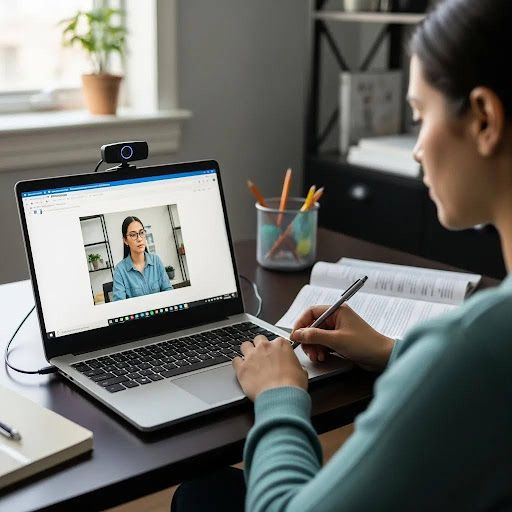
The New York permit test can be taken online in certain situations, but it requires meeting eligibility and technical rules. Online tests use remote proctoring: you register, verify identity with a government ID, set up a webcam-monitored testing area, and complete a timed exam under supervision. Knowing the technical requirements and the step-by-step flow prevents last-minute problems that could invalidate your session. Below we cover who qualifies and walk through the online testing process.
Who Is Eligible to Take the NY Permit Test Online?
Eligibility for online testing depends on age, parental consent for minors, and the ability to meet proctoring requirements like a stable internet connection and a webcam-equipped device. Minors typically need a parent or guardian for identity checks, while adults must present the same identity and residency documents required for in-person testing. You’ll also need a quiet, well-lit room and a webcam positioned to show your face and surroundings. Confirm eligibility and prepare documents and your testing space in advance to lower the risk of delays or disqualification.
What Is the Process for Taking the NY Permit Test Online?
Follow these steps to take the NY permit test online and meet proctoring rules:
- Register for an online permit test: Complete the testing vendor’s pre-registration and schedule your session.
- Prepare identity documents: Have your government ID and any required proofs ready for on-screen verification.
- Set up your testing environment: Choose a quiet, well-lit room, clear your desk of unauthorized materials, and position your webcam to show your face and work area.
- Complete identity and room scan: Follow proctor instructions to show your ID and pan the room as requested.
- Take the timed exam under supervision: Stay on camera for the full session, follow proctor prompts, and submit the test for scoring.
What Are the Next Steps After Passing the New York Learner’s Permit Test?
After you pass the learner’s permit test, you’ll need to complete required pre-licensing education, follow Graduated Driver License (GDL) restrictions, and log supervised driving hours before scheduling your road test. The sequence is straightforward: get your pre-licensing certificate, complete the supervised practice hours tied to your age and GDL stage, then schedule the road test when eligible. Knowing the order — certificate, supervised hours, then road test — helps you plan practice and avoid delays. Below we explain the 5-hour pre-licensing course and summarize GDL stages and restrictions.
What Is the 5-Hour Pre-Licensing Course and Why Is It Required?
The 5-hour pre-licensing course is a required class for many New York permit holders that covers safe driving, responsibilities, and what examiners expect on the road test. Completing it earns a certificate you must have to schedule the road test. The course focuses on defensive driving, crash-avoidance strategies, and practical rules-of-the-road — all topics that directly improve road-test performance. Approved course certificates are needed to reserve a road test, and many providers offer flexible or online formats. Pairing a Permit Preparation Course for the written test with a scheduled 5-hour class is a common, effective approach.
How Does the Graduated Driver License Law Affect New Drivers in New York?
New York’s Graduated Driver License law phases in driving privileges to reduce risk for new drivers. It places limits like nighttime driving restrictions and passenger caps for teens so new drivers gain experience under lower-risk conditions before earning full privileges. Knowing the specific restrictions at each stage helps families plan supervised practice and avoid violations that could delay licensure. Following these rules and completing required education are necessary steps before scheduling the road test and receiving an unrestricted license.
Next we explain how to schedule your road test and offer practical tips to prepare for test day.
How Do You Schedule and Prepare for the New York Road Test After Your Permit?
What Are the Requirements to Schedule the NY Road Test?
To schedule a road test you typically need a valid learner’s permit, a pre-licensing certificate, and access to a legally registered, inspected vehicle with current insurance. You must also meet applicable age and supervised-hours requirements. Schedule online or by phone through official DMV channels; wait times vary by region. Bring original documents to the test and confirm your vehicle meets eligibility rules so you’re not turned away. Planning ahead avoids rescheduling and keeps you on track for licensure.
How Can You Best Prepare for the NY Road Test?
Use a structured practice schedule: start with basic vehicle control, add maneuvers like parallel parking and three-point turns, and finish with full mock tests in realistic conditions. Key focus areas are vehicle control, observation and signaling, defensive positioning, and correct lane use in traffic. Practice with a checklist and guided sessions, and get feedback from experienced supervisors to fix small errors early. Mock tests that replicate examiner instructions help steady nerves and build the automatic responses examiners expect.
- Below is a concise vehicle- and test-day checklist to verify readiness before heading to the test.
- Valid learner’s permit and pre-licensing certificate are present and current.
- Vehicle registration and proof of insurance are accessible and match the vehicle used for testing.
Where Can You Find Official Resources and Support for the New York Drivers Permit Test?
The New York DMV supplies the authoritative Driver’s Manual, forms, and scheduling tools you’ll need for permits and licenses. Complementing those official resources with third-party practice tests and video lessons can make rules easier to apply in real situations. The best preparation combines study of DMV materials (the Driver’s Manual and official guides) with supplemental practice tests and short video lessons that turn rules into practical decisions. Below we outline DMV support and the features to look for in third-party prep tools.
How Does the New York DMV Support Permit Applicants?
The New York DMV publishes the official Driver’s Manual, issues application forms, and provides scheduling, vision testing, and guidance on required documentation. These materials are the legal and procedural foundation for permits and licenses, so rely on them for authoritative rules. The DMV also offers in-person and online services for appointments and issuance. Use DMV resources for forms and requirements, then pair them with targeted practice tools to create a complete study plan.
What Online Traffic Safety Courses Are Available for NY Permit Test Preparation?
Online prep courses vary from focused permit modules to full bundles that include practice exams and road-test readiness. The most effective courses mix interactive quizzes, video lessons, and full practice exams that reflect DMV formats and state-specific content. When choosing a course, look for state-specific question banks, instructor-designed explanations for tricky topics, and practice that mirrors the test experience. For learners who want guided, simulated practice, Online Traffic Safety offers a Permit Preparation Course with audio, video, and quizzes built for flexible, self-paced study that builds confidence before the DMV test.
Beyond the Learner's Permit: Commercial and Specialized Driving Training
This guide focuses on the New York learner’s permit, but many people pursue further qualifications. For professional opportunities, a Commercial Driver’s License (CDL) opens career paths in transportation.
About the Author
Sarah Jenkins is a seasoned expert in driver education and traffic safety, with over 15 years of experience helping new drivers navigate the complexities of licensing and road safety. Holding certifications in defensive driving instruction and a deep understanding of state-specific DMV regulations, Sarah has developed curriculum for numerous driver training programs across the country. Her passion lies in empowering individuals with the knowledge and skills needed to become confident, responsible, and safe drivers. Sarah regularly consults on driver education policy and contributes to resources aimed at improving road safety outcomes.
Who we are
Featured links
Get in touch
-
info@onlinetrafficsafety.com
Connect with us
-
Facebook
-
Twitter
-
Youtube
-
Instagram
-
Linkedin
-
TikTok